|




















|
We are sorry to announce that Stone House Day IS NOT BEING HELD until further notice. |
   (Houses close promptly at
Showing several of “America’s Oldest Private Homes”
Stone House Day
Stone House Day at Hurley, New York
A visit to the country offers fresh air, memories, friendly residents, and a less-hectic pace. Where especially can you go to find this? Hurley, New York and Stone House Day on
This quaint village will stimulate your senses as you make your way touring through
300 year old stone houses. The homeowners of these houses graciously open their homes just one day a year.
The homes were built from Stone House Day carries a visitor into a historic past that gives the viewer a chance to compare similarities and differences of lifestyles today. Each house has a historical background, a story or folklore told by colonial clad guides. The houses on Main Street (which will be blocked off to traffic) and the houses reached via a shuttle bus may be toured at the visitor’s pace.
And there's more! Stop by and spend some time at a militia re-enactor’s campsite; sit and listen to an organ recital or be entertained by the colonial period instrumental ensemble; enjoy a performance about Sojourner Truth; visit a cross-stitch crafter, a working blacksmith; browse the garage sales, two antique shops, the Hurley Historical Society Museum, the Hurley library book sale and the Ulster County Genealogical Society. Refresh your appetite with homemade food available at Schadewald Hall at the Hurley Reformed Church. The church has sponsored this event for
the past Tour tickets cover all events, stone house tours, shuttle bus and parking:
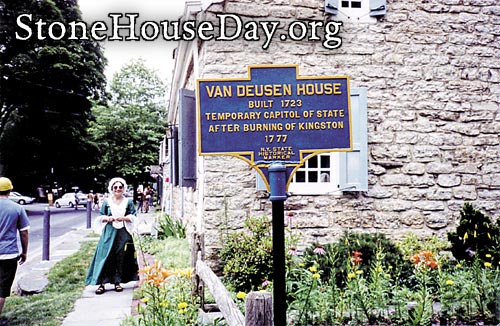
Houses On Tour:The Van Etten/Dumond (Spy) House, built prior to 1685, is the oldest colonial stone house in the Town of Hurley. From October to November of 1777 this house was used by the Continental Army as a guard house. Prisoners and a “spy” were held in its basement. More can be heard about the spy and his demise during your tour. The Jan Van Deusen House, built in 1723 as a rural Georgian cottage, holds historical interest as well. The parlor served as the meeting room for the NYS Committee of Safety. This committee was compiled of legislators who made laws and spent monies to benefit the state’s participation in the Revolutionary War. In its day, a two-story stone house indicated a family’s wealth and social standing. Dr. Richard Ten Eyck, at the age of 28, was the first to build such a home on Main Street as a wedding present for his wife Jenett Baker in 1786. Dr. Ten Eyck not only owned but ran the village brewery, distillery and grain mill, as well as a part of the family orchard business. A farmer, Jonathan Crispell built his original stone house, also on Main Street, early in 1725. Generations of Crispbell’s held onto their Hurley home until it was sold in 1836 to the Hurley Reformed Church to be used as a parsonage. While touring the Crispell house, mix the past with the present and view a display of cross-stitch work, learn the basics of cross stitch and take home your efforts. Children and “the young at heart” of course are welcome. Continuing on Main Street is an original stone house known as the Colonial Jonathan Elmendorf House, built from 1783–1790. It now houses the Hurley Heritage Society Museum. The museum’s exhibits presently mark both the area’s bluestone industry and the Revolutionary War period. Delve into a quarry drivers’ workday, view a film on minutemen or browse through the materials that enable you to envision our past lifestyle.
Other Events to See:A working blacksmith will be demonstrating his trade, helping the visitor see how much labor and skill went into providing his services. In colonial times a blacksmith was an extremely important tradesman for he not only made tools, wheels, and numerous household items, but he repaired the tools for farming, fixed carts, wagons and other necessities. See, touch and hear the sights of the 3rd Ulster Militia encampment. Watch and hear the firing of colonial muskets, talk with the members of the Militia, the Seneca and Mohawk Indian re-enactors, ask questions regarding the displays of their clothing, cooking skills, guns, knives and tentage. Visitors of all ages will be able to take a moment and transport themselves by walking back in time into a militia encampment. Sojourner Truth was a forthright woman. Debra Zuill, an accomplished thespian, portrays this famous woman of history in a skit called “Ain’t I a Woman?” Experience Sojourner Truth’s manner of dealing with prejudice and the lack of women’s rights, observe her independence and brave demeanor. You will feel, through Ms. Zuill’s presentation, the tenor of the mid-1800’s when black and white women had few privileges or freedoms.
For further information, contact:
The date is always
|